Wednesday, 20 October 2010

Day 34 - Mara Triangle

It was time to leave the amazing Masai Mara & Kenya. Breakfast was early but nothing like the 4am start the previous morning. We'd be driving most of the day to reach our next camp across the border in Tanzania on the banks of Lake Victoria. There was no time for meandering across the plains looking for animals. The drivers were on a mission. We did stop a couple of times including for this warthog family. They're odd creatures. They crouch down on their front knees to eat the grass.

We reached the Mara River close to where we'd been the previous afternoon. There's a narrow bridge across the river right where the Mara flows into Tanzania. It's the only bridge over the river in the entire reserve. I can't fathom why the wildebeest & zebra don't use the bridge, but wild animals are understandably wary of man made structures. On the other side of the bridge is a ranger station & more importantly, a toilet (the toilet block is in fact in Tanzania). While we were stopped to relieve ourselves in Tanzania, we also checked out a beach of sorts next to the bridge (below). The beach is the scene of carnage where hundreds of wildebeest have been washed up having not made it across the river. Injury, drowning or crocodile attack all factor toward this macabre scene. It's an easy meal for the scavengers.

An overnight lion kill had this mob of vultures interested. The killers were nowhere to be seen & were probably lying under a tree sleeping & digesting.

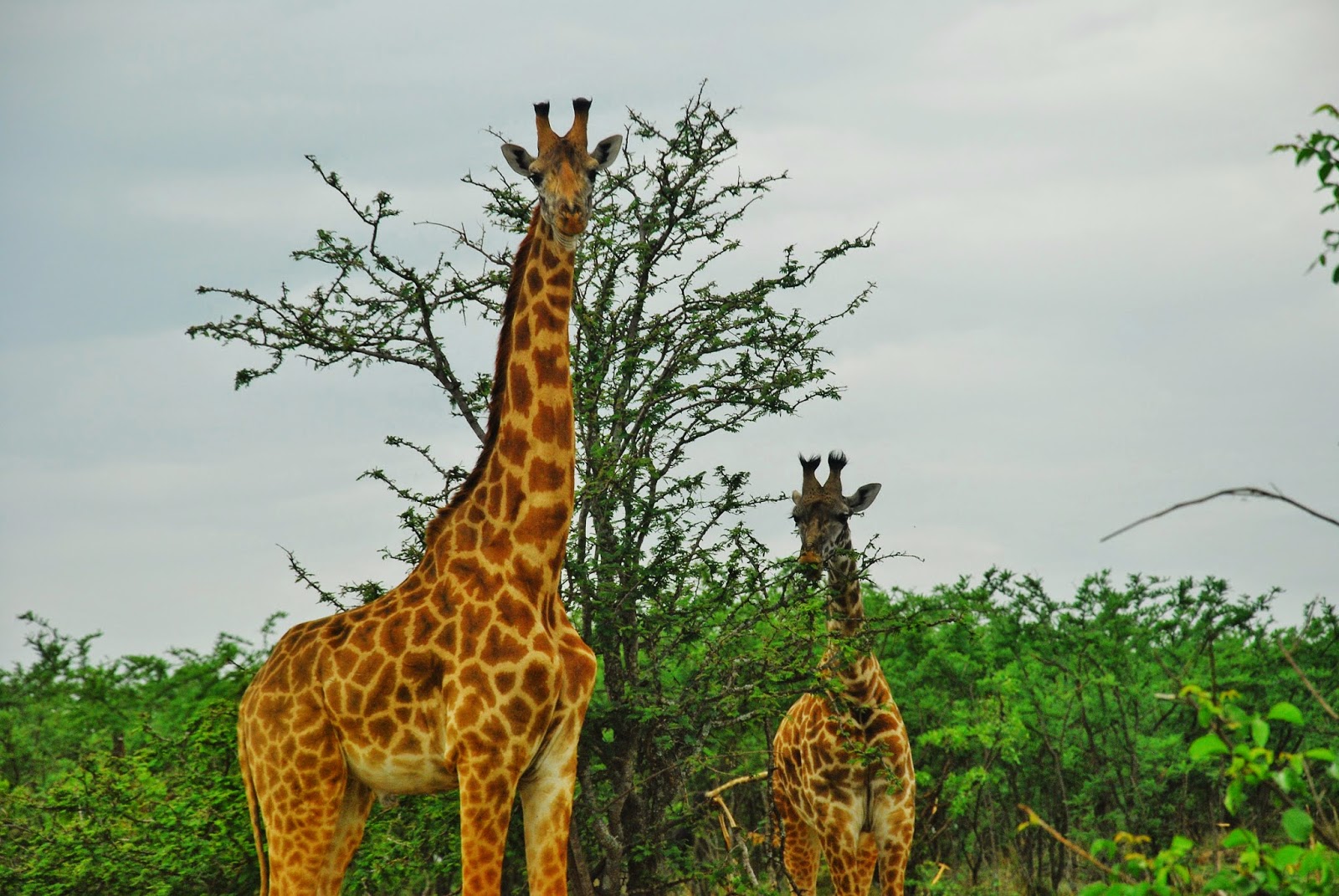
Just in Tanzania a few giraffe were enjoying the acacia leaves.
The Western third of the Masai Mara bordered by the Mara River to the East, the Tanzanian Border to the South West & the park boundary to the North West is called the Mara Triangle (map below).
We didn't have time to explore the area properly because we still had a long way to go & the onset of rain was making our two drivers nervous (more on that later). It was a shame because it's a beautiful part of the park and was loaded with animals at the time. Most of the migration had already crossed the Mara River and were moving through the Triangle & into the Serengeti to the south. The animals that are injured crossing the river make easy pickings for the predators in the Mara Triangle. The Hyenas were the first to appear. They'd elusive to see to so far only being spotted in near darkness when we couldn't see them properly let alone photograph them. This one was really quite close to the van & was looking straight at us & sniffing the air as though we were food! Hyenas get a bad rap but they have their place like every other animal of the Savannah.
Not a mile up the road lions made their grand entrance. Two lionesses with three cubs were at a wildebeest kill. The wildebeest was a mess & the lions all had distended stomachs. There was no way the lions were leaving the carcass to the hyenas.

One of the cubs found a tasty morsel left behind.
She had a bit of a pick at it then wandered back to the others. Maybe her tummy was full after all.
One of the lionesses wasn't done either.
The vehicles were probably disturbing her so she decided to drag the carcass behind a dirt mound where she could have some peace.
 Once again, we were forced to move on. It was such a shame because we were on a roll now! The overcast/rainy weather made it cool enough for the predators to do something other than sleep.
 Another mile down the road & the luck continued. A loan cheetah wandered across the road in front of us then right alongside the van! The temptation was to reach out & pat it but a rush of sanity made me pull my hands & head back inside the window!
We tracked north beside the Mara River toward the Oloololo Gate. The lush vegetation attracts a number of water loving creatures. The elephants were in their element playing in a shallow pool at a bend in the river before munching on the long green grass.


The waterbuck love the water & the green vegetation as well. This doe was comfortable enough to nurse her fawn.
The Mara Triangle was the first place we saw Uganda's national emblem, the Crested Grey Crane (below). They strut around showing off their extravagant head wear.

Regrettably we reached the Oloololo gate. Regrettable because we had to leave the incredible Mara. We'd had such a fantastic time in this unique reserve.
Right after leaving the park, the road headed straight up the Oloololo Escarpment. Once the rocky track levelled out we were very suddenly in farmland. The zebra & wildebeest disappeared & were replaced by goats, cattle & those annoying people things. I'd become accustomed to the park where nature was protected & farmers were shunned for the most part. I'd forgotten that the Mara is surrounded by relatively highly populated farms & villages. The track became very muddy & slippery & it became abundantly clear why the drivers were in a hurry.


The 4WD vans and our very capable drivers managed to do an excellent job of keeping us from getting us into trouble... Unlike others... The yellow truck (above) was in some trouble, but not as much as the beached safari truck (below). The safari trucks rear wheels had lost grip & slid off the road. Once the centre of the chassis touched the crest of the road they were stuck. It would take them some hours to get out. We did see them again a couple of days later so they made it out without being mugged by the locals (and that's a real risk).
We eventually hit tarmac which was a welcome relief after 3 days on the rough stuff. It was only another 10 kms to the Tanzanian border. We had lunch in the big car park at the border post & said good-bye to our trusty drivers with their amazing 4wd Toyota vans. I take back anything bad I may have said about the vans at the start of the tour. Commo (below) & the other driver took us across to the Tanzanian side of the border to meet the drivers who would take us all the way to Arusha. The Kenyan drivers would then leave us & head North then East along the sealed road that skirts around the Mara Reserve & eventually back to the main highway we'd been on so many days ago on the way to Nakuru. That would lead them home to Nairobi around 7pm that night. A tough day at the office for those two. Thanks guys.
We transferred our gear into our new vehicles (below) & sorted out or visas & passport stamps. The new trucks are affectionately called Arusha Specials. They're Toyota Landcruiser troup carriers that get some special modifications in Arusha. The modifications include stretching the body, cutting a hole in the roof & adding a wildlife viewing hatch, installing extra cushy seats, adding big side windows, and installation of power points for camera chargers & a travel fridge to name a few. Toyota in Japan have come to Tanzania to look at these machines intending to make genuine versions in the Toyota factory. These are purpose built safari vehicles that are bullet proof. I still think the vans are a bit more comfortable & have better vision but without the power points & fridge. The Arusha Specials are much more effective at traversing rough terrain.
We'd been sharing the van with Verena & Fabien for the last few days but decided to be sociable & change it up for the second half of the trip. Catherine & Peter were going to be our travel buddies this time. We met our new driver, Luis & started chatting away & getting to know him a bit better.
The Tanzanian roads were flatter & wider than the Kenyan ones & it was a nice relief from the bumpy roads of the last 3 days or so. Tanzania didn't seem anywhere near as heavily populated as Kenya. The farms were much larger & less densely planted. The scenery had changed as well. There were lots of volcanic rock outcrops and the hills & valleys were much more dramatic than where we'd been.
About an hour into the drive we crossed the Mara River (below). The river flows from the Masai Mara snaking south then West & into the giant Lake Victoria. This crossing was quite near the lake.
At the end of a 2-1/2 hr drive we reached our tent village beside the mighty lake. I think we were all very happy to be out of the vehicles after spending the whole day in them. The camp has a nice main building with a bar & dining area. We would be in tents (nice tents) that would follow us for the rest of the trip. The biggest attraction was the brand new shower block with proper showers with water pressure & even hot water! We were very excited! The "squat toilets" weren't really my thing but were better than the grotty mosquito infested toilets in the Mara.
We relaxed by the lake's edge for the last little bit of daylight with a few beers. Our new Tanzanian chef cooked up a storm for dinner (a sign of great meals to come). The lights from the dining area attracted a swathe of moths (below). They were leaving little dust trails in front of the spotlight.
After dinner we had some more beers before turning in for the night. For once we didn't need to be up early in the morning.

Tuesday, 19 October 2010

Day 33 - Hot Air Ballon & Masai Mara

The alarm went off at 4am. It was going to be a long day but a memorable one. The hot air balloon company picked four of us up at the camp for the hour & a half drive deep into the park to the balloon launch site. Vehicles aren't allowed to drive around during the night hours in the Mara, but the Balloon operators have an exemption. We were half asleep & there was no moon to light up the landscape. We saw no animals other than a lone bat-eared fox. We reached the launch site just as the first touches of colour were painting the sky. The crew was already inflating the balloons when we arrived. They start with big fans then once there is a decent amount of volume they light up the burners.
High altitude (1500m above sea level in the Rift Valley) is mainly responsible for the hot air balloons in Kenya & Tanzania being some of the largest in the world. (High altitude means they need more hot air volume to carry the same load). The burners brightened up the morning through the red & yellow balloon.
We were told to pack away our cameras for take off to avoid damage & more importantly so we could hold onto something & not fall out of the basket. Once we were up & away the cameras came out. Even after we'd lifted 30 feet or so off the ground the true nature of the Masai Mara became abundantly clear. The seemingly endless grass plains criss-crossed by tree lined creek beds are an ideal habitat for both herbivore & carnivore.
Shortly after we took off we saw the fist glimpse of sun sneak over the horizon. The fact that we were climbing made the sun look like it was rising more quickly. Stunning isn't it?
Once the spectacular sunrise had lost appeal & spread some light on the Mara it was time to get down to some serious wildlife spotting. What was intriguing was the lack of any animals in the park. It wasn't until we were further west that we started seeing a few animals. First it was an ostrich then a few warthogs. Clustered around a few trees were half a dozen Masai Giraffe (below). These hugely tall mammals looked so small from high in the sky.Drifting along in the breeze we were tracking along a creek with some small pools. We could see animal paths alongside the creek and, if you look closely at the photo below next to the pool, one of the path's creators, a hippo! Hippos come out of the water at night & feed on the grasses on the plains. This one was heading back to the pool for a day of lazing around.
Our pilot allowed the balloon to drop very close to the ground to the point where I thought we were going to land on the hippo we'd seen before! Just before we hit the hippo & the nearby trees she lit up the burners & we climbed up & away to safety.As we approached one of the larger hills we started to see more animals including a column of wildebeest (below) heading toward the Mara River. Could it be they were part of the great migration that hadn't been seen as yet?
Our pilot (who does this pretty much every day for 6 months a year) berated us us for not spotting 3 cheetah brothers (below). Can you see them? It took us a while with the naked eye from the balloon as they were so far away. To put some perspective to it, the photo below was taken with a 300mm zoom lens and has been cropped to about a quarter of its original size. I thought it was a bit rough of the pilot to have a go at us for not spotting them, particularly as she'd seen them in roughly the same place the morning before. It was exciting that technically we'd seen one of the three spotted cats.
We started to see more animals including the largest antelope, the Eland (below). They also migrate with a millions of wildebeest, zebra & Thomson's gazelles.
On the whole, the plains were seemingly void of animals. There were only a few scattered herds close to the creeks & trees.The plains wouldn't be barren for long. A little way in the distance we saw a much bigger gathering of animals (around the balloon's shadow below).Looking over toward the second balloon we saw more animals underneath it. What a sight! The endless plains, the animals & the balloon were lit up wonderfully by the early morning light.Then almost suddenly, we saw the countless wildebeest & zebra of the great migration! Amazing! So many large mammals in one place. As it turned out we also saw where we'd be having breakfast (above centre), under a lone tree. The animals were clearing out of the reserve leaving the plains desolate in their wake.
Having spoken to the pilot about the migration, I now know that is incredibly rare to see the migration still in the Mara in mid October. All the research I'd done appeared to have given me an incorrect read. Normally they've all crossed the river by the end of September. The migration was still lingering in the Mara due to the rains in the Serengeti being quite late this year. Apparently the females were already in Tanzania & the remaining animals were predominantly males. There were only 500,000 or so left North of the Mara River. Still, what a spectacle! Fortunately there would be huge numbers of animals in the Serengeti as well. Luck was definitely on our side.Not long after we'd found the massive herd, we found ourselves heading for a tall hill with a giraffe standing century. The pilot announced we were about to land so it was time to pack away the cameras again & prepare for what can best be described as a controlled crash.We'd had such a good time & we didn't want it to end but there was only so much fuel on board & we weren't far away from the Mara River & the Tanzanian border. Besides, it was time for breakfast! It was hard to believe we'd been in the air an hour!
The champagne breakfast had most of the usual western breakfast options but there aren't too many places in the world where you can sit eating breakfast within a few hundred metres of tens of thousands of wild animals. We said good-bye to our Aussie balloon pilot (centre) & set off in the yellow 4x4 that had picked us up at 4am. The driver took us on a game drive for a couple of hours before meeting up with the rest of the GAP group. He initially took us to the Mara River where we saw some of the aquatic game animals. There were many hippos lazing beside or in the water dwarfing the legendary Nile crocodiles.
Tucked under the shrubs lining the bank of the Mara were two young male lions. Judging by the bite marks in the side of this one's face, I'd say this one & his brother had been in a fight with other male lions. The poor guy looked in lots of pain. It's a tough life for bachelor males.
We saw a troupe of mongoose just near the lions, but they were so fast we couldn't get a photo of them before they'd disappeared into the bushes.
The driver set off back through the middle of the migration. It was slow going because the wildebeest weren't at all threatened by the vehicle. We were to meet the rest of the group back at the Keekorok Airstrip which was back near where the launch site was so we had plenty of time to animal spot on the way. As from the balloon, the herd went from being thick mass to nothing. It was like that for half the way to the airstrip. The odd grazing animals were scattered across the plains but in total contrast to the wandering mass of the migration. At a high point with what looked to be a man made dam of sorts was a small lion pride. They were hiding in the shade under a truck trailer that probably bought the bulldozer (nowhere to be seen) to the site. One of the lionesses (below) had taken a liking to an old oil container & had chewed it much like a your puppy at home would.
From a little way off the pride male came wandering in. Judging by the extended stomach, they'd had a big meal during the night.
Seems the old boy was thirsty.
Right about the time we started seeing a few zebra again an aircraft landed just near us. It was late morning by that time. We were at the Keekorok Airstrip. It was exciting for a couple of reasons. We'd be able to catch up with the others & swap stories (we were dreading that they may have seen an elusive leopard); and the airstrip had flushing sit down toilets. I think the toilets took first priority for some having not had an opportunity since 4am. Getting out of the vehicle for a leak in these game parks carries a huge amount of risk.
Our yellow Landrover driver headed back to his balloon crew & we organised ourselves back in our vans. Oddly we started back along the same road we'd just come in on, but at least we weren't in a rush so we were able to study the animals in full sunshine. We'd seen topi (below) late the evening before from far away. They're quite a big antelope with striking black markings.
It took a little while longer to realise that the topi were hiding a few of their youngsters in the long grass (below). Young topis make great snacks for cheetah, hyena & other predators.
Next to a lush creek another antelope was munching on the lush green grass. Waterbuck have the longest hair of the African grazers. They spend a lot of time in the marshes & water so maybe it keeps them from getting cold in the rainy season. Apparently the long hair also makes them less palatable to a lion which is a huge advantage in the African savannah.
So there we were snapping away at the waterbuck.......Being the wildlife nut that I am, I figured I'd scan the surrounding area for other animals.
Bingo!
I saw something moving in the long grass about hundred yards out. I didn't get too over the top because I've been caught out on other wildlife trips. It was probably a jackal, but something looked different from my first glance. You can just see it in the centre of the picture. I took a photo and zoomed in to see what it was........
A SERVAL!
I was so very hopeful that we'd see one of these distinctive little cats but had resigned myself to the fact that we likely wouldn't. Of the three African spotted cats, these are the least seen but not rarest. Our guide & driver hadn't seen one of these for well over a year & they're in the parks a lot of the time.
Servals are very good at hiding in the long grass and are very secretive. They have huge ears for locating small prey in the grass & long legs to they can jump for birds or rodents. They're about twice the size of a domestic cat. This male didn't seem too bothered by us when we moved the vans closer to him. He continued his search for lunch before disappearing into a clump of grass. A serval in broad daylight! I was buzzed!
Charged and on high alert we were all excited about what else lived in this awesome place.
Masai Giraffes were the next to draw out attention. Masai Giraffe are not endangered like their Rothschilds cousins but that doesn't make them any less interesting. Their brown patches are more ragged than the Rothschilds Giraffes. More like jigsaw pieces.
Giraffes are a trees next worst enemy after an elephant. They can reach leaves where none of the other animals can.You don't have to travel too far in the Mara without seeing a warthog family. They're not the prettiest animal in Africa, but make up for it with character. They run around with their tails in the air making them easy to spot in the tall grass.
We returned to the dam & the trailer with the lions. They had hardly moved but that's what lions do during the day. Nothing.
Having seen the three cheetah brothers from the air we tried to lead our drivers back to them using the photos we'd taken & land marks that we'd seen from the balloon. Eventually we did find cheetahs, but not the brothers. Instead (thanks to some radio chatter by the drivers) we found a mother (below) and her near full grown daughter.
Africa has given me a renewed affection for these fragile & much endangered cats. Being so close to them in the wild was a real treat & I would have been quite happy sitting there watching them all day.
The young female was quite active while her mother relaxed & half asleep. What beautiful animals.
We stopped for lunch in the middle of noware under a tree. There were no animals within a kilometre of us so it was quite safe to hope out of the vans (so they told us). There was no shortage of evidence of animals. Wildebeest dung was everywhere. Once lunch was pack up, we were back in the vans heading toward the Mara River & the great herd. It wasn't long until we were amongst thousands of wildebeest & tommies again. The animals had a real sense of urgency about them which is hard to explain. They were all headed toward the river. Soon we were beside the river at pretty much the same area we'd been a few hours previous.
The Mara River doesn't seem like a raging torrent but it has a formidable current & is quite deep. The hippos & crocs seem to like it but I'm sure the migrating animals are terrified of it.We found the lion brothers again but there were three this time. The temperature had dropped off a bit so they were more alert this time.
The wildebeest had begun to assemble at the river bank. The numbers steadily built up with some of them running to the waiting herd. We waited for ages with the animals about to cross a number of times. Two hours we waited. We moved a few times, but it turns out that the park rangers were blocking them on the opposite bank in their 4x4. We were not pleased, but what do you do? We couldn't have all the luck that day.
It was getting late by the time we gave in on the wildebeest that had started heading back to the plains. Maybe they'd try again the next day. We drove back toward the lodge seeing many wildebeest & tommies for a short while before travelling through endless abandoned grassland.
Close to where we'd seen elephants the day before we saw another small family group. One of the younger femals had a nursing calf. They're such peacful animals for the most part.
We saw the big lion pride from the previous day as well. Once again they were being lazy. The light was starting to fail so we didn't hang around long.
Close to the park gate it started to rain a little. It became quite dark suddenly. The rain clouds combined with the rapid sunset but the park had one more surprise in store. Two hyenas were running around making pests of themselves. The few wildebeest & impala were understandably restless.
We had dinner back at camp & went to bed early. It had been a long day but with so many wonderful moments. A day that will stay in my memory for a long time to come.