Wednesday, 27 September 2023

Leaving Canyon Village


This morning greeted us with another sharp chill, as temperatures once again dropped well below freezing. After spending three nights in Canyon Village, we’re now heading to West Yellowstone where we'll stay for the remainder of the Yellowstone leg of our adventure.


With the car packed and ready, we took advantage of the early start to scout for wildlife along Dunraven Pass, but unfortunately, it proved to be a bit of a letdown—even the usually reliable bison were nowhere to be seen.


We made a quick return to Canyon Village to pick up some rolls for lunch before commencing our journey along the Norris–Canyon Road toward West Yellowstone. We have several planned stops and scenic attractions enroute.


Tower Fall and Dunvegan Pass


 After wrapping up our Mammoth tour, we made our way back down the now-familiar route to Canyon Village. Along the way, we paused at Tower Fall, taking extra time to soak in the surrounding scenery, starting with the waterfall itself.


During our walk along the trail to the falls, we spotted an interesting little creature—a woolly bear caterpillar—minding its own business.


A nearby roadside pullout offered a striking view of the Yellowstone River winding past Tower Fall.


Looming above the area is the impressive volcanic basalt formation known as Overhanging Cliff, casting its shadow over the viewpoint.


After leaving Tower Fall, we headed up Dunraven Pass toward Mount Washburn, pausing at several lookout spots in hopes of spotting a rare bear or wolf. 


Although we faced a few letdowns along the way, our patience paid off when a coyote appeared just a few metres from the lookout!


We were thrilled as we watched him trot down the hillside and disappear into the tall, dry grass—blending in so seamlessly he was nearly impossible to spot.


At the next scenic stop, we had another memorable wildlife encounter—this time with a massive bison bull. Unfazed and determined, he stayed his course, bringing traffic to a standstill in classic Yellowstone fashion.


The bison slowly made his way toward the lookout where we were parked, grazing as he went. He strolled directly beside and in front of our car, paused to scratch himself against the wooden barriers, and then calmly continued up the hill.


Although we felt a bit uneasy being so close to such a massive animal—especially one known for its temper—we kept a respectful distance, and he paid us little mind. It was yet another incredible wildlife moment we’d been hoping for since the day began.


As we began our descent into Canyon Village, we made time for one final lookout stop. From this vantage point, we could take in the dramatic ravine of the Grand Canyon of the Yellowstone, with the distant, snow-capped peaks of the eastern ridge of the Yellowstone Caldera stretching across the horizon—a fitting end to our day of exploration.

Mammoth Hot Springs - Upper Terraces


Upon arriving at Fort Yellowstone in the Mammoth area, we made our way to the dining room for lunch before setting off to explore the famed Mammoth Terraces.


We began our visit at the Lower Terraces, where elk lounged once again on the pale, mineral-coated steps—just as they had a few days earlier. 


This area also marks the beginning of the boardwalk that winds its way up and around Minerva Terrace clinging to the hill above.


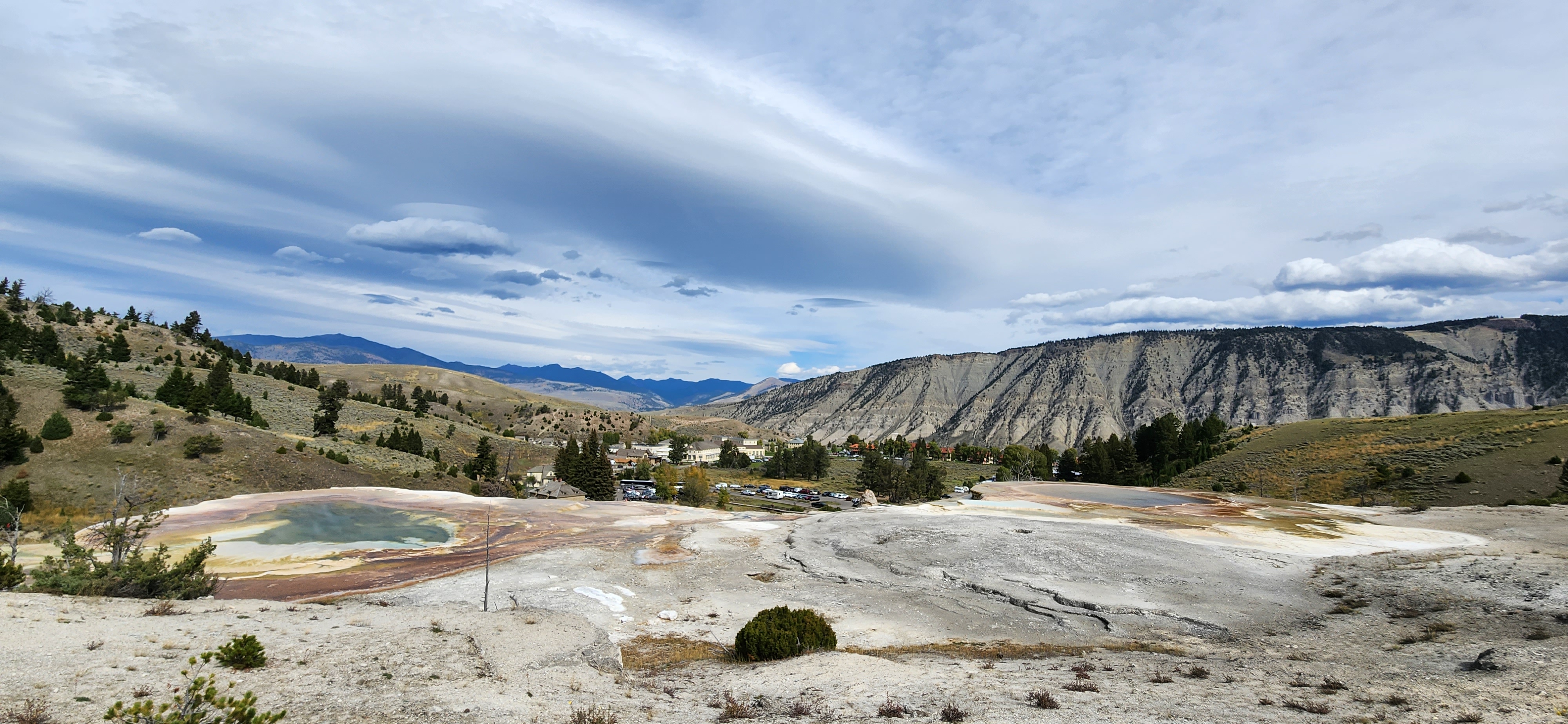
While Minerva Terrace itself felt somewhat underwhelming, the sweeping views overlooking Fort Yellowstone and the winding Gardiner River Valley, as it flows into the park from Montana to the north.


Near the trail’s end, you’ll find a vantage point overlooking Palette Springs—the thermal source responsible for feeding the brilliant white formations of the Lower Terraces.


After returning to the car, we made our way up the hill to the Upper Terrace Loop,that lets you view various geothermal features from the comfort of your vehicle. While many of the formations are relatively modest, one particularly striking highlight is Orange Spring Mound, which shimmered in the sunlight with vibrant, mineral-rich hues.


Angel Terrace stands out as another prominent feature of the Upper Terrace area. Its brilliant white mineral deposits are so strikingly bright, they could easily be mistaken for fresh snowfall.