It was a tough night with the camp facilities out of action. The lions and hyenas were making it very clear that wandering off into the scrub to relieve ourselves was a very bad idea.

Daybreak finally arrived showing those of us up early enough another spectacular Serengeti Sunrise. Instead of searching for leopards in the Serengeti after breakfast, the plan was changed to searching for flushing toilets. The airstrip came up empty (literally as the water tank was dry). Fortunately the Visitor Centre not far from the camp came up trumps for us. Clean sit down flushing toilets. We were probably more excited in this discovery than a leopard!

There were plenty of interesting animals at the Visitor Centre to entertain us while we were waiting for everyone to finish their business. There was a band of pygmy mongoose that seemed to have the run of the place. No doubt they play cute & get snacks off the tourists. Could you say no to these little faces?

The mongooses didn't have complete control of the Visitor Centre. A family of Rock Hyrax (below) were sharing the prime positions with the mongooses.We eventually found our way back to the vehicles & were off to scour the Serengeti for leopards & other animals.

Not 100m away from the visitor centre another family of mongoose were on the move. This time they were Marsh Mongoose (below). They weren't as friendly as their pygmy cousins at the Visitor Centre.

Our two drivers followed the creeks which is where many of the less common animals tend to congregate. Certainly the hippos weren't leaving the water during daylight hours.


The abundant water close to the creeks allowed the trees to grow large attracting a myriad of birds including a couple of big eagles. The Bateluer Eagle (above) was nowhere near as menacing as the Marshall Eagle (below).

There were other birds that were less intimidating. The Little Bee-eater (below) is such a colourful little bird with seemingly not a care in the world.

We eventually strayed away from the creek & out onto the plains again. There were so many zebra, Tompson's gazelles & wildebeest! They weren't as concentrated as in the Mara, but the numbers were still staggering. We added another antelope to the list. The heartebeest (below) is a close relative of the wildebeest but nowhere near as abundant. They get their name from their heart shaped horns & faces (apparently).

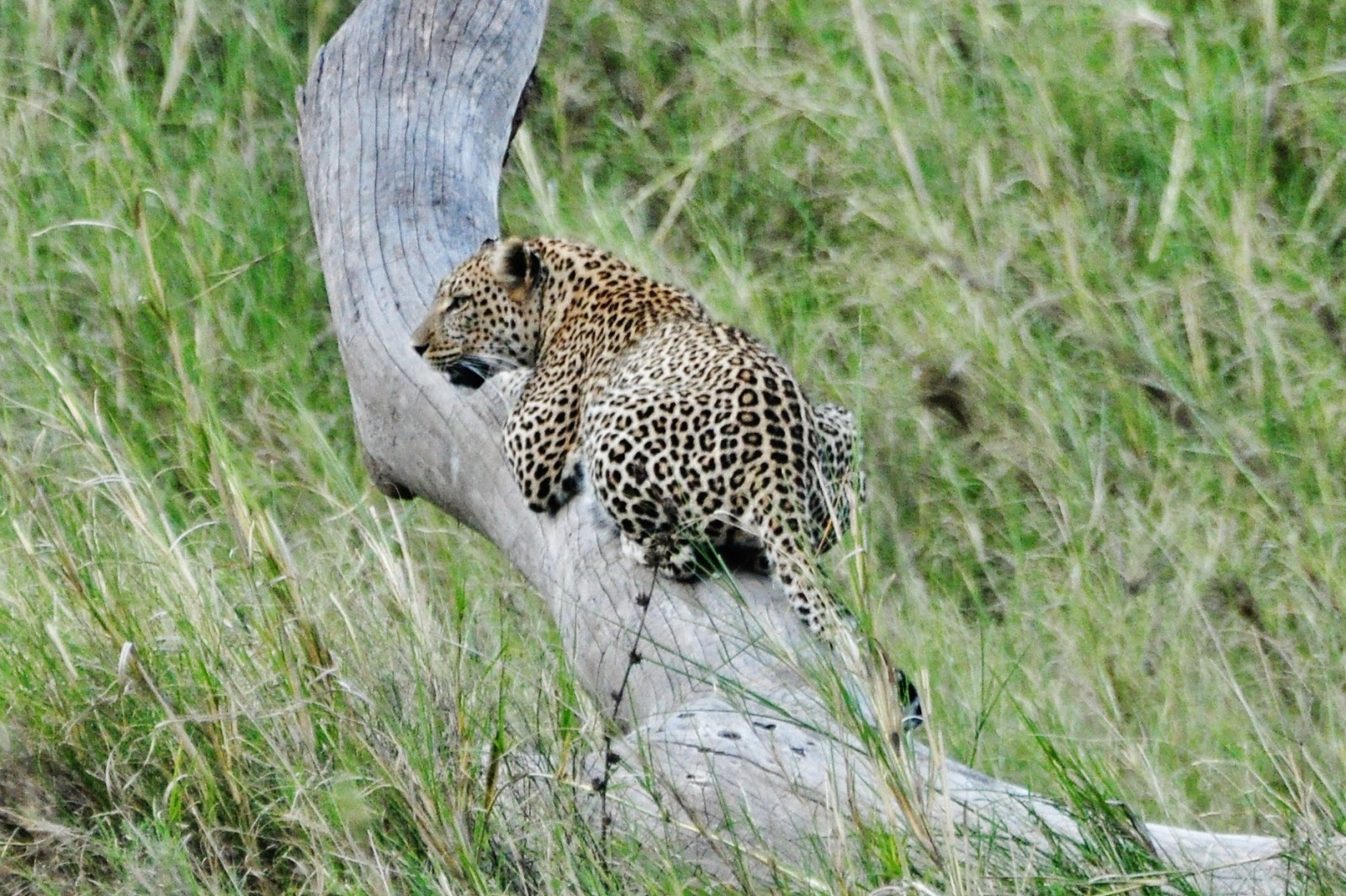
Out in the middle of the vast plain was a small rocky outcrop. It was covered in trees & vines & the road did a circuit around it. There were a large number of vehicles around it & we soon realized why. Up at one of the highest points hiding in the thickets was a leopard. You can just see the spotted yellow fur in the picture below. This was the leopard shot I had expected to get from our trip but after the luck the previous day, this was just disappointing. There's a good chance that she had cubs hidden away in one of the many crevices out of sight. She snuck away out of sight so we moved on. We'd come back to this place again in an hour or so.

The Serengeti is a real stronghold for the cheetah. We ended up seeing quite a few in the 3 days we were in the park.

We spotted this male lazing around being a cat. He didn't seem too worried about giving away his position to his prey.

After quite some time he got up, yawned, stretched & wandered off toward the longer grass.

We were hoping he'd then go & hunt for a meal but instead he found a tall tussock of grass & hid from our cameras (below). Cheetahs merge into the long grass with ease.

Another animal that is doing very well for itself in the Serengeti is the elephant. We saw so many in the park. Instead of the families of six to ten we'd seen in Kenya, most Serengeti groups were well over 20. The first big herd we saw (below) had 29 individuals including 2 youngsters.

The older of the two calves could have been a year old & was bulking up very well thanks to the abundant vegetation.

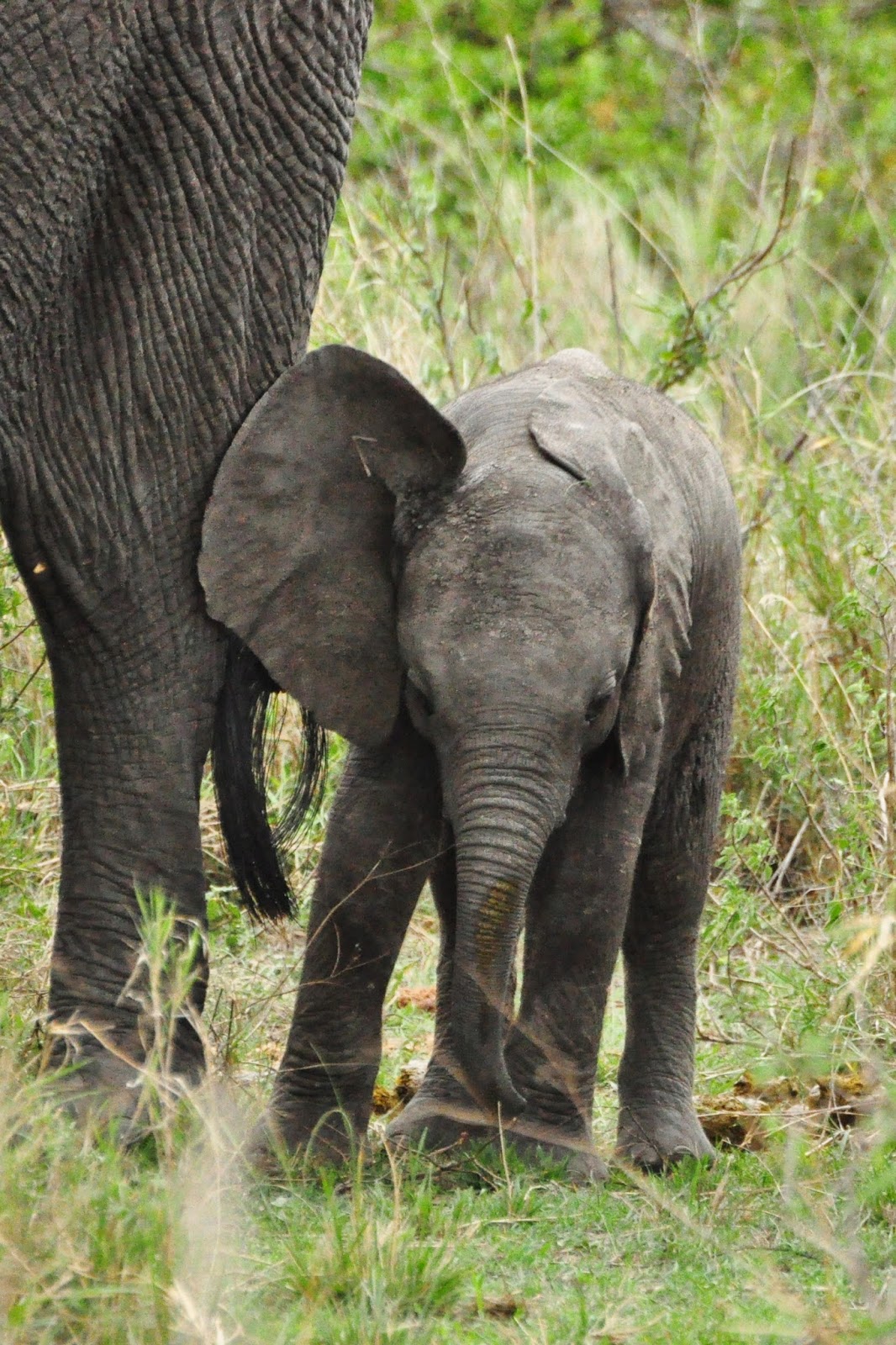
The herd was very protective of the younger calf who was probably only a couple of months old. There was no way a lion or leopard was going to snatch this little one.

We drove into a hilly part of the park only to find more elephants. This time it was a couple of bulls. I suspect they were shadowing a herd of females we would see nearby.

The Kori Bustard (below) is an interesting bird. It's the largest flying bird in Africa. They don't fly that much as it must be hard work with all that bulk, but I imagine it keeps them from being picked off by the cats. We'd see more of these birds in the crater in a couple of day's time.

The lions had been somewhat elusive in the Serengeti. It wasn't that we didn't see them, more that they were too far away to get a good look at them.

We did eventually see a couple of lionesses. Maybe a mother & daughter. The bigger cat was wearing a radio collar as I'm guessing the researchers were keeping a close eye on her. She was also heavily pregnant. Maybe that was why she was picked to wear the collar. The younger cat was sitting nearby watching the endless meals wander by.

We back tracked toward were we'd seen the bull elephants. They were now a little way off in the distance but a herd of females had appeared where we'd seen the bulls.

We counted 27 in this family. They also had a very young calf. This one looked very unsteady on its feet and wouldn't have been more than a few weeks old.

If you look closely at the photo below you can see a couple of white spots on its chest. They're ticks! The little elephant's hide obviously isn't quite thick enough to deter the horrid blood sucking insects. I imagine the grass is infested with ticks considering the number of animals available to latch onto.

On the way back to camp for lunch we stopped again at the leopard's castle. We were very surprised to see a bull elephant clambering all over it.

Elephant's aren't known for their climbing prowess but the lure of green vegetation must have been enough to encourage him to take the risk.
 Elephants have quite the reach when you add their body height & long trunk.
Elephant's aren't known for their climbing prowess but the lure of green vegetation must have been enough to encourage him to take the risk.

He slowly worked his way around the outcrop getting ever closer to where the leopard was hiding out. The poor cat must have been terrified but was smart enough to go into hiding until the danger had passed. The elephant eventually left the castle & wandered out onto the grasslands again.

We headed back to camp for lunch but not before stopping on the camp entrance road for a lioness sitting on a rock overlooking her territory. This was probably one of the lions we could hear during the previous night.

Lunch was ready for us when we arrived. Our trusty cook had managed to continue his high standards even at lunch.

We relaxed for a couple of hours before the afternoon game drive. The drive started with word on the radio of a leopard. Unfortunately we didn't make it in time & turned around only a couple of minutes from the cat sighting. It wasn't a total loss because we'd managed to take a road where a family of bat-eared foxes were living. These are normally nocturnal creatures & we were very surprised to see a family above ground during the day. The three little fox kits were very busy fighting each other & annoying their two parents.

During the day we saw quite a few pairs of secretary birds (below) combing the grass for snakes & lizards.

I hadn't expected to see lovebirds (below) on our trip. These are very popular as pets the world over & you tend to get used to seeing them two at a time, not 30-40 of them in a flock. It was great to see them free in the wild.


The male Thomson's gazelles were all getting feisty so the breeding season must have been getting close.

The Topi & Eland (below) tend to stay away from the huge wildebeest & zebra herds.
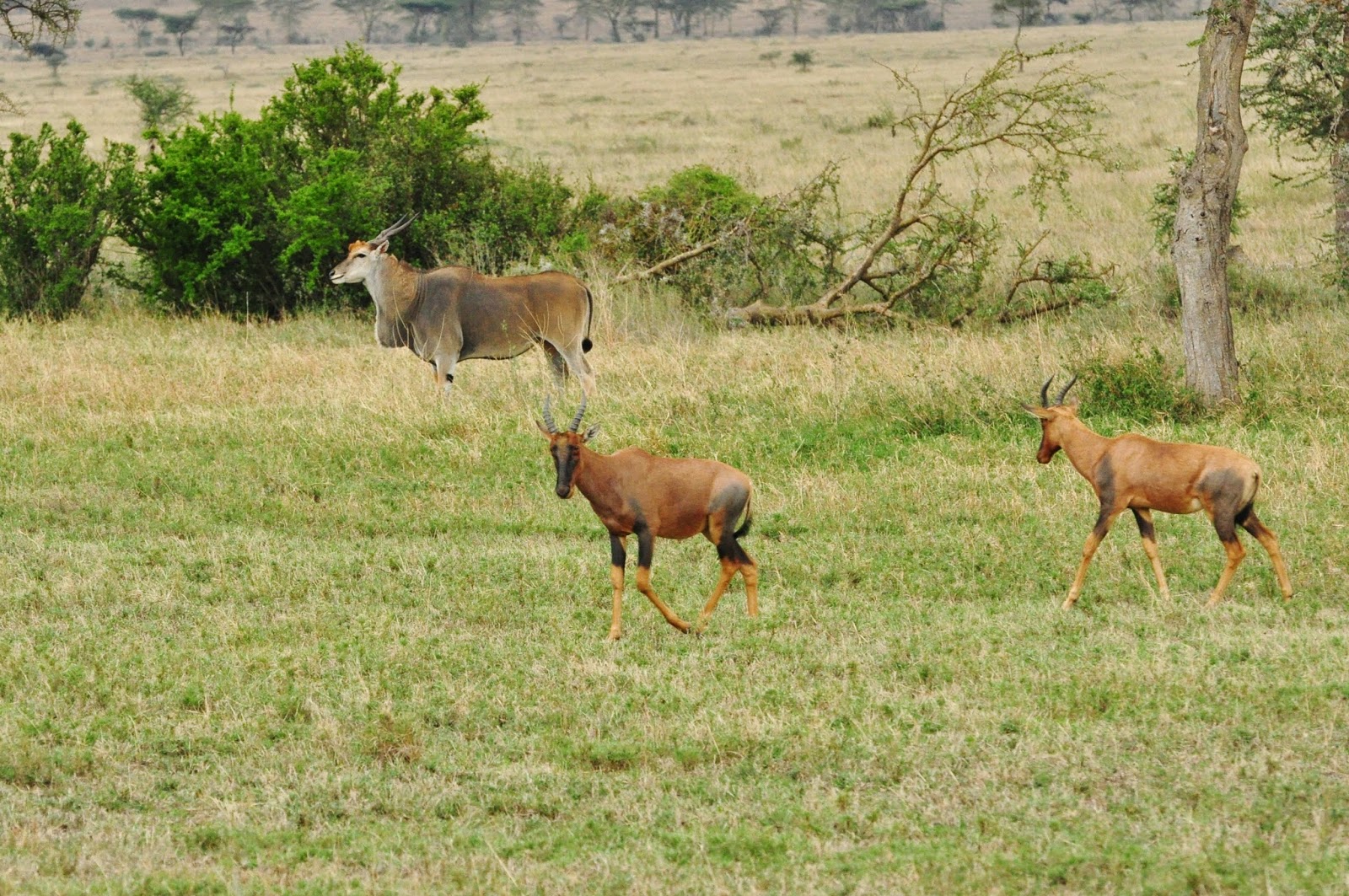
The eland must have been infested with insect parasites because it was being mobbed by ox pecker birds. As much as the big antelope needed the birds to help rid it of pests, the ox peckers had become a pest themselves.


The changing colours in the sky signaled the end of the game drive. We hadn't seen any giraffes today because we'd been far away for the tree for the most part. It was nice to finally see a couple of these graceful animals.


Light rain started falling during dinner & put a dampener on the evening camp fire. The camp ablutions were slightly better than the previous night with the water tanks full & there weren't any other groups staying that night. It didn't stop us getting up in the middle of the night for a comfort stop. As I was watching for danger a bat-eared fox ran in front of me. They must search the camp for food scraps when all the campers are asleep. Back in the tent we could hear what was probably a Cape buffalo eating grass behind us.
The light faded quickly thanks to some building storm clouds & the
short sunset period so close to the equator. The last photos I took
before the light beat the camera was of the boys sharpening their claws
on a tree (below).


 We quickly found out that the Serengeti, like the Mara, has endless grass plains but is much flatter than its Kenyan counterpart. The grass was green from the resent (but late) start of the rains in the Northern half of the park. We could already see many of the migrating animals already spreading out across this vast grasslands.