Kerri had been building up for this day for months. The main reason she wanted to go to Africa was to see the mountain gorillas. I can't say I was as excited, but I was still amped up for the experience. A 5.30am start and early breakfast allowed us to get to the park HQ on time. Along the way we were able to get a better look at the row of five extinct volcanoes that form the boundary with the Rebublic of Congo (Mt. Sabyinyo above).


At the park HQ we were given the run down about the lay of the land, how we are expected to behave around the gorillas & were introduced to the family we would visit (our family was the family called Sabyinyo).

Robert followed the convoy carrying the other 6 members of our hiking party. We started hiking from the car across the farmland that was only recently inside the boundary of the national park. There's now a wall along to boundary to stop the farmers encroaching & to stop the buffalo destroying the farmland.

When we'd asked for a short hike if posible, we didn't think a 10 minute wander across farmland before hopping over the wall into the jungle (above) was what they mean by a short hike. None the less, that was our hike & we weren't complaining. We've since heard horror stories about 3 hr hikes followed by an hour of hacking through stinging, thorny jungle. We had to bush bash for a couple of minutes to find the animals.

We could hear the gorillas even from the wall & could see evidence of both buffalo & gorillas on the ground (and nearly stepped in it a few times). Then there he was, Guhonda (above & below), the big silverback. He's the biggest gorilla in the park & the guides said he weighs 250kg. I find it hard to believe (maybe they mean pounds), be he's a big boy for sure.


As we set ourselves & were quiet, we became aware of other members of the family rustling around in the vegetation. GiIhishamwotsi (or maybe it's Shirimpumu) was up in a tree eating leaves (below).

Ishejabben (nicknamed Big Ben) is an odd one. He is easy to spot thanks to his bald head.


Kampanga (above) has a new baby of only a few weeks. This family not only has the biggest gorilla in the park, but also the smallest (below). Cute little guy isn't he? Some say he looks like Elvis.

Most of the family settled down for a sleep with Guhonda the protector of the group with one eye open for trouble.


Meet Gukunda (above & below), the Prince. He's Guhonda's son & a silverback in training. Apparently Guhonda knows that he's getting old & his reign will be over soon. He lets Gukunda take some privileges with the females that in normal circumstances he would not. Gukunda's quite a big boy like his father. Apparently he eats a lot & chooses the plants that ferment in his stomach the most. Consequently he is drunk much of the time. We could see he was a bit grumpy & a bit unsteady.

The other members of the group were quite elusive. They were either in really dark places where the camera couldn't see them or in the thickets where we couldn't see them.
Unfortunately, we had to leave. In the best interest of the animals, the human interaction is kept to an hour per day. It felt like 5 minutes, but we'd been there over an hour!

Back at the park HQ, we were all given certificates to prove we were there (because the photos aren't proof enough).

Robert drove us to a lodge on a ridge nestled between two nearby lakes. We had lunch and watched a storm cross the lake & past us. It was all very civilized.

The local birdlife wasn't too fussed even if one of the white necked ravens did look a bit bedraggled.

That night was more of the same as far as dinner & power failures. We turned in for the night still buzzing from the experience.
 The first of three wildlife centres was the Nairobi Safari Walk. It's basically a small zoo with a number of the popular African animals. The main intent of the place is to educate the local school kids. As a tourist, it also you to see any of the animals you may miss on safari. There are also breeding programs with some of the endangered animals such as the Pygmy Hippos (above) from the Republic of Congo in West Africa.
 The interaction people are allowed with the animals is much more relaxed than in the western world. Our guide picked some leaves for us that we were able to feed to the colobus monkeys.
 The white rhino (below) didn't seem anywhere near as cranky as it's reputation would suggest. The guide again grabbed some leaves & it came up to the fence for a snack.
 There were two albino zebra at the Safari Walk. These were captured from the wild when they were very young to save them from being picked off by predators. In Africa it doesn't pay to stand out from the crowd. They've become a bit of a novelty.
 There are a few lions that lay around & sleep a lot (just like most lions). There is also a leopard (below). A mob of school kids had been through just before us & had driven it up the tree. In typical leopard fashion, it made sure there would be no postcard photos.
 From the elevated walkway around the leopard enclosure we could see over the fence into the National Park. The impala (below) being wild animals were very nervous & soon trotted off into the scrub.
 The Kudu (above) & the Bongo (below) were a couple of antelope species that we didn't end up seeing on safari.
 Meet Candy the cheetah. She's the Safari Walk's other spotted cat. Cheetahs are much more slight than their leopard cousins, particularly the females. They're still magnificent cats and much more inclined to allow you to take their photo.
 I did mention that the human interaction was relaxed. We were taken into Candy's enclosure and allowed to pat her like a domestic moggy. You would think it would be all very contrived & controlled, but she seemed to enjoy the attention. She was purring the whole time & exhibiting some of the affectionate behaviours of our two cats at home. Many people in Africa keep orphaned cheetahs as house pets as they are by far the easiest of the big cats to tame. I'm not sure how you'd go trying to get them off the kitchen bench.
 Unfortunately we had to say good-bye to Candy & rush to our next wildlife stop, the elephant orphanage.
 Baby elephants who's families have fallen the victim of poachers are bought to the orphanage & hand reared. Once they are older, they are introduced to wild herds of older elephants that are themselves orphans. It's a great program that has some wonderful results.
 The orphanage also adopts rhinos. Many are released into the neighbouring Nairobi National Park. We were busy watching the elephants play around when a black rhino (above) emerged out of the scrub. Apparently this one is an orphan that is now wild & free but occasionally visits the people that gave it a fighting chance of a normal life. This was the best look at a black rhino we'd get on the trip.
 The baby elephants all have very sad stories. Elephants are known for their long memories & you have to wonder whether they carry the horror of what happened to their families all their lives.
 The elephants are quite boisterous especially when they are near water and when milk is on offer. One or two of the larger orphans took the bottle off the handlers & wouldn't let it go until the milk was gone.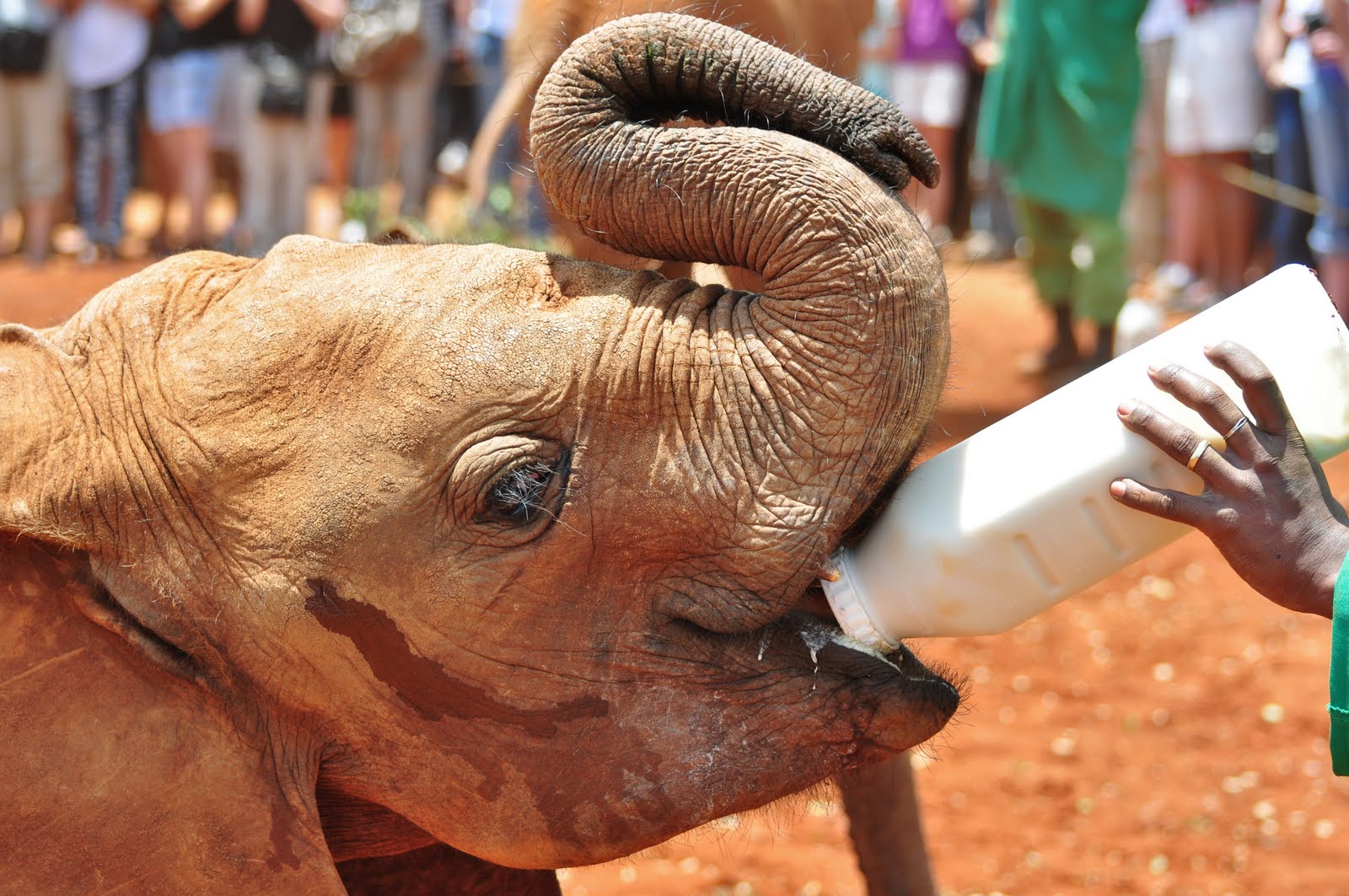
 At some point the animals decided it was time for stacks on (above). The smaller ones probably weren't overly appreciative, but there was no harm done.
 The herd were led off to another part of the complex signalling the time for us to move on as well.
 Our last stop for the day was the giraffe centre. This centre was set up to save the Rothschild's Giraffe that were down to a wild population of 130 individuals. Thanks to the centre, the population across four national parks is now at 300. Zoos around the world are now part of the effort.
 Once again, the interaction with people is more relaxed. The giraffes come right up to the building where you can feed them little pellets. If you're mad (like Kerri below) you can encourage them to give you a very wet kiss by putting one of the pellets between your lips. Yuk! The giraffe's name is Kelly.
 Warthogs are quite the opportunists. They take advantage of the kindness of the tourists scavenging anything the giraffes miss.
 We exited the giraffe centre via the Zoovenir Shop & back to the car.
 Our driver took us to a garden restaurant near the giraffe centre. The meal wasn't bad if a bit expensive. The setting was nice & there were lots of birds including the weever bird below.
 That evening we met the group we'd spend the next 9 days with. As is usually the case with Gap Adventures tours, you have a get together the night before setting off on the trip. There were two missing from the meeting but we met the other four & our guide, Mosses. Suzi, Fabien & Verena were from Germany & Keiko is a Gap tour leader on holidays from Japan. The two missing, Catherine & Peter from Toronto, would appear the next morning. It would be a good mix of nice people to travel with.

 Sharing the garden with the weever birds were regal sunbirds (below).

 We eventually reached Kigali. Robert gave us a more detailed tour of the city this time. What I noticed was the wide range of housing. At one extreme was the mud houses built side by side & at the other end of the spectrum, the massive gated mansions of the foreign diplomats & some of the politicians. In the middle, the government is busy building a huge number of mid range houses.
 The flight took us East over the rolling hills then flood plains of Rwanda before flying over Lake Victoria. I knew Lake Victoria was big, but until we'd flown over it I had no idea quite how big. It was getting dark by the time we landed in Nairobi (and it gets dark very quickly near the equator). The taxi ride to the hotel was interesting. It became abundantly clear that Nairobi was a busy city. Even in the seemingly endless traffic jam there were locals coming up to the car trying to sell us things.

 Robert picked us up around 9 & took us for a drive around Kigali. The thing that became apparent quite quickly was the hills. The whole city is built on a series of ridges & valleys. The city centre (above) is located on top of a hill. It isn't what I'd call a big city, but there are a lot of people living there. The slums (below) are scattered across the city but are being replaced with new housing built by the government & partially paid for by foreign aid.
 Unfortunately Rwanda is most famous for its bloody past, particularly the genocide of 1994 when 850,000 people were killed. Robert took us to two of the churches where some of the atrocities were carried out on defenceless people who were sheltering there. They're disturbing legacies preserved to remind locals & visitors alike not to ever let it occur again.


 We flew with Brussels Airlines (Rwanda is a former Belgian colony) but it meant we had to transit through Brussels. We had two things against us. The hour & a half flight from London on the Avro RJ85 (above) was delayed & the airport in Brussels is a mess with the terminal splintered and connected only by bus. We even had to get on a bus from the first aircrat to the terminal. It was a major (and sometimes confusing) scramble but we made it onto the A330 (apologies for the blurred photo below) bound for Africa. The airline attendants are really nice and the service good on Brussels Airlines, but there's no entertainment system in the head rest in front of you. The scenery was clouds over Europe & Egypt & the Sudan were a featureless brown desert from the air. The long flight was very, very long. It was 9.30pm local time when we touched down in Kigali, the capital of Rwanda.
 We were met at the airport by our personal guide, Robert (below). He was recommended by one of Kerri's work friends who had been over there with a medical team. Robert takes the team on safaris every year when they visit.